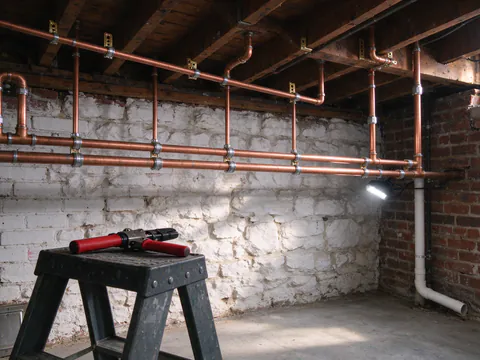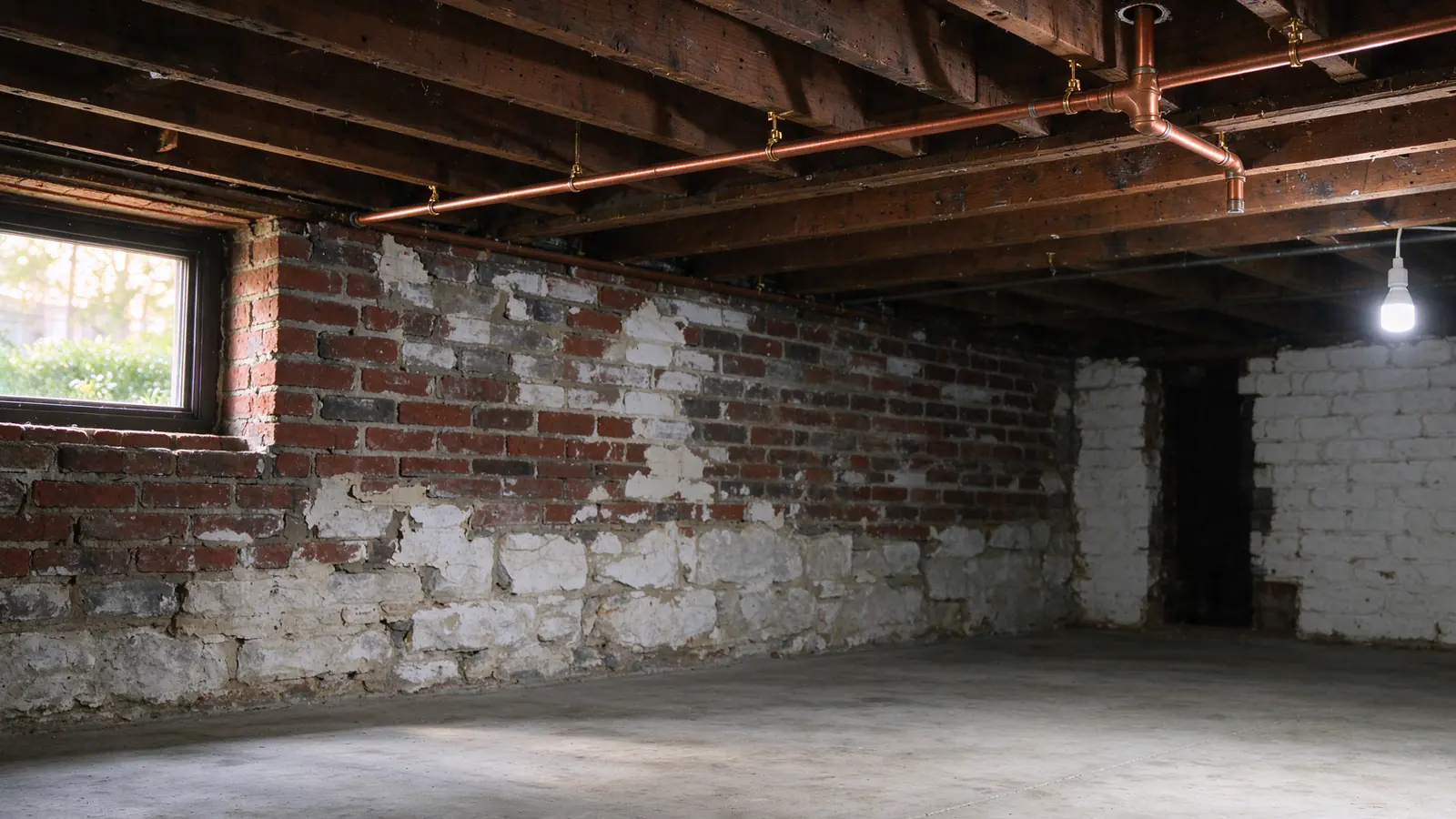
Copper pinhole leaks have no single cause. Water chemistry, high flow velocity, workmanship such as leftover flux or unreamed pipe ends, and electrical conditions can each pit copper from the inside. One pinhole in otherwise sound pipe is usually a repair. Repeated leaks in different runs point to a system-wide cause, where a repipe makes more sense.
Philadelphia Freedom Repipe offers and manages copper repiping, PEX repiping and partial repiping across Philadelphia and nearby Delaware, Montgomery and Bucks County suburbs, carried out by licensed and insured contractors. Copper is durable but it is not permanent, and a pinhole is a question about the whole system as much as the one spot that is wet. This guide explains the causes, how to read the pattern, and how to choose a scope.
How copper fails
Copper resists general corrosion well, which is why it replaced galvanized steel. Its usual failure is local: a small pit starts on the inside wall and deepens until it breaks through as a pinhole. The outside of the pipe often looks fine until a drip, a green or blue crust, or a water stain on the ceiling below gives it away. Hot lines and the pipe just after elbows and tees are common places for it, because that is where heat and turbulence are highest.
A copper pipe that has one pit may have others at an earlier stage. That is why the location of the leak, and what the inside of the pipe looks like, matter more than the leak itself.
The possible causes
Water chemistry. The balance of hardness, alkalinity, chloride, disinfectant and corrosion inhibitor in the water affects how copper’s protective film forms. In Philadelphia that balance varies by treatment plant. The Philadelphia Water Department’s 2025 drinking water quality report puts average hardness at 101 ppm for the Baxter plant, 151 ppm for Belmont and 169 ppm for Queen Lane, and chloride ranges differ by plant too. PWD adds zinc orthophosphate, which forms a protective coating inside pipes.
Flow velocity. Water moving too fast wears the inside of copper, especially on hot lines and just downstream of fittings. Undersized pipe, a recirculation pump running too fast, or a short run feeding a heavy demand can push velocity up. The wear often shows as smooth, horseshoe-shaped pits in one direction.
Workmanship. Too much flux left inside a joint keeps attacking the copper after the job is done. A pipe end that was cut but not reamed leaves a burr that creates turbulence. Overheated joints, debris left in the lines, and pipe that was kinked or dented during installation all start weak points. Workmanship pits tend to cluster near joints from one particular job.
Electrical conditions. Metal water piping is often part of a house’s electrical bonding. Stray current on the piping, or a poor bond, can contribute to corrosion in some cases. It is less common than the other causes, and an electrician is the right person to check it.
Installed conditions. Copper in contact with dissimilar metals without the right transition, such as copper joined straight to galvanized steel without a dielectric union or brass fitting, corrodes faster at that joint. Houses part-way through a galvanized pipe replacement have several of these transitions. Pipe resting against masonry or exposed to moisture from outside can corrode from the outside.
No single cause explains every case, and several can act together. Any explanation that blames one factor for every pinhole in every house is too simple.
What Philadelphia’s water does and does not explain
PWD’s corrosion control appears to work for copper at the system level. In its 2025 Lead and Copper Rule testing at 106 homes, the 90th-percentile copper result was 0.210 parts per million, and none of the 106 homes was above the 1.3 ppm action level. Low copper in water at the tap means copper is not dissolving broadly across the system.
It does not rule out pitting in one house. Pitting is local: it can happen in a single run because of velocity, a bad joint or an electrical problem while the rest of the city’s copper behaves. So a pinhole in a Philadelphia house is not evidence of a citywide water problem, and it is not something to dismiss as bad luck either.
Reading the pattern
| What you see | What it suggests |
|---|---|
| One pinhole, pipe around it sound, no history | A local defect; repair the section |
| Several pinholes near joints from one remodel | Workmanship on that work; replace that section |
| Repeated leaks on hot lines, near elbows | Velocity or temperature; check pipe size and any recirculation pump |
| Leaks in different runs, cut-out section pitted along its length | A system-wide cause; a repipe of the copper is likely the better value |
| Corrosion where copper meets steel | A missing or failed transition fitting |
Repair, partial repipe or whole house
A repair cuts out the leaking section and joins in new pipe. It is the right answer for an isolated pinhole in sound pipe, and the removed piece is worth looking at. If the leak is on the line at the meter, the main water shutoff replacement page covers work at that end of the system. A clamp is a temporary stop, not a repair.
A partial repipe replaces the copper in one area, such as one bathroom group or the hot lines, when the leaks are concentrated there. The scope should say exactly what old pipe stays and how the new pipe joins it.
A whole-house repipe makes sense when leaks keep appearing in different runs, because each repair then only moves the next failure along. The new system can be copper or PEX. If PEX replaces metal piping that formed part of the electrical bonding, the bonding needs checking by an electrician. The PEX vs copper repipe guide explains the choice, and in Philadelphia non-residential spaces must stay metallic.
On cost, there is no separate public range for a copper repipe or a partial one. A whole-house repipe in the Philadelphia area typically runs $4,000 to $15,000+, and larger homes and copper jobs can pass $20,000; the repiping cost guide covers the drivers. Philadelphia Freedom Repipe replaces failing copper after a walk-through that maps the leak history and the runs, and every new system is pressure-tested and flushed before walls close. The old water pipes guide and the guide to identifying your water pipes give the wider context.