Philadelphia Freedom Repipe replaces the water supply piping in Philadelphia rowhouses, twins and detached houses, and in nearby Delaware, Montgomery and Bucks County suburbs. A whole-house repipe takes every hot and cold line out of service from the main shutoff to the fixtures and replaces it in the material the code allows for the building. Inside the city, a licensed master plumber oversees the work and pulls the L&I permit, and the job is planned around the plaster, the people living in the house and the inspection.
The case for replacing all of it at once is practical. Galvanized steel corrodes from the inside along its whole length, so a leak or a weak shower in one spot says something about the rest. Fixing one section at a time keeps old pipe in service next to new, with more cutovers and more openings over the years. If the trouble is confined to one bathroom group or one riser, a partial repipe can be the better scope, and the Philadelphia repipe cost guide shows how the two compare.
What happens on the first visit
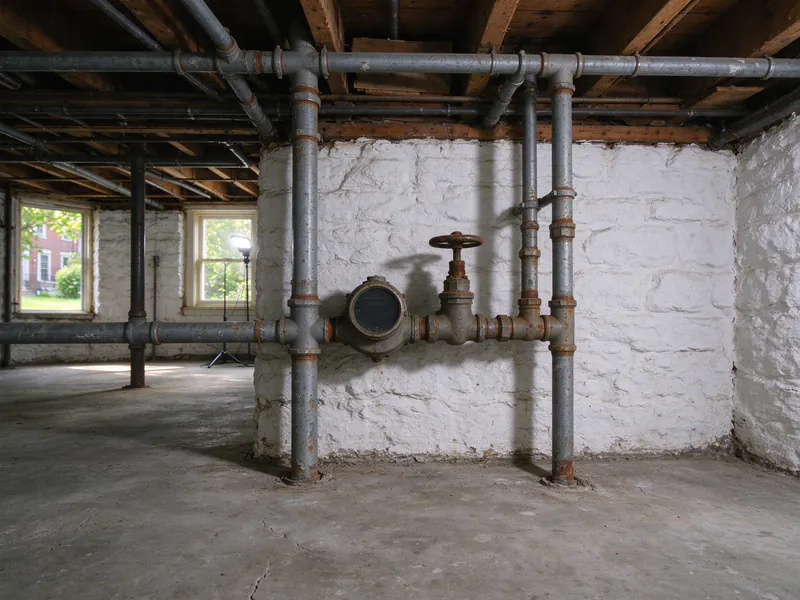
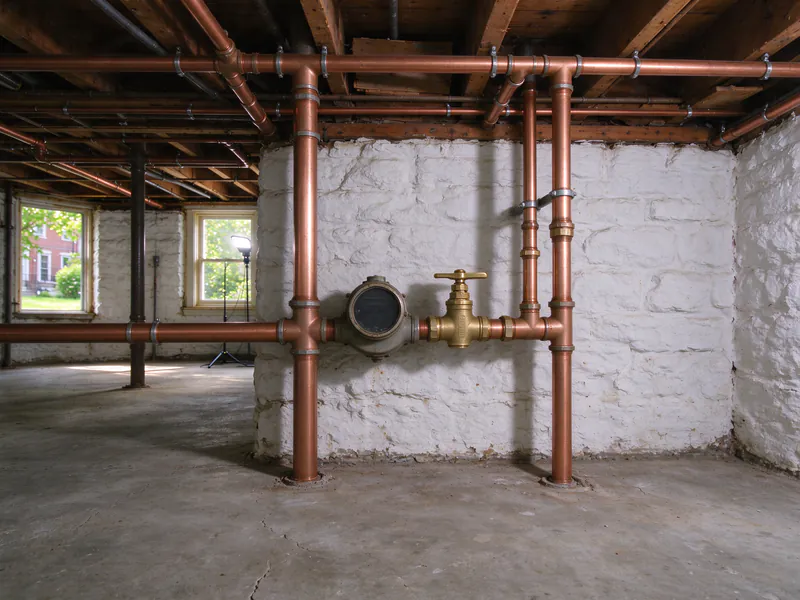
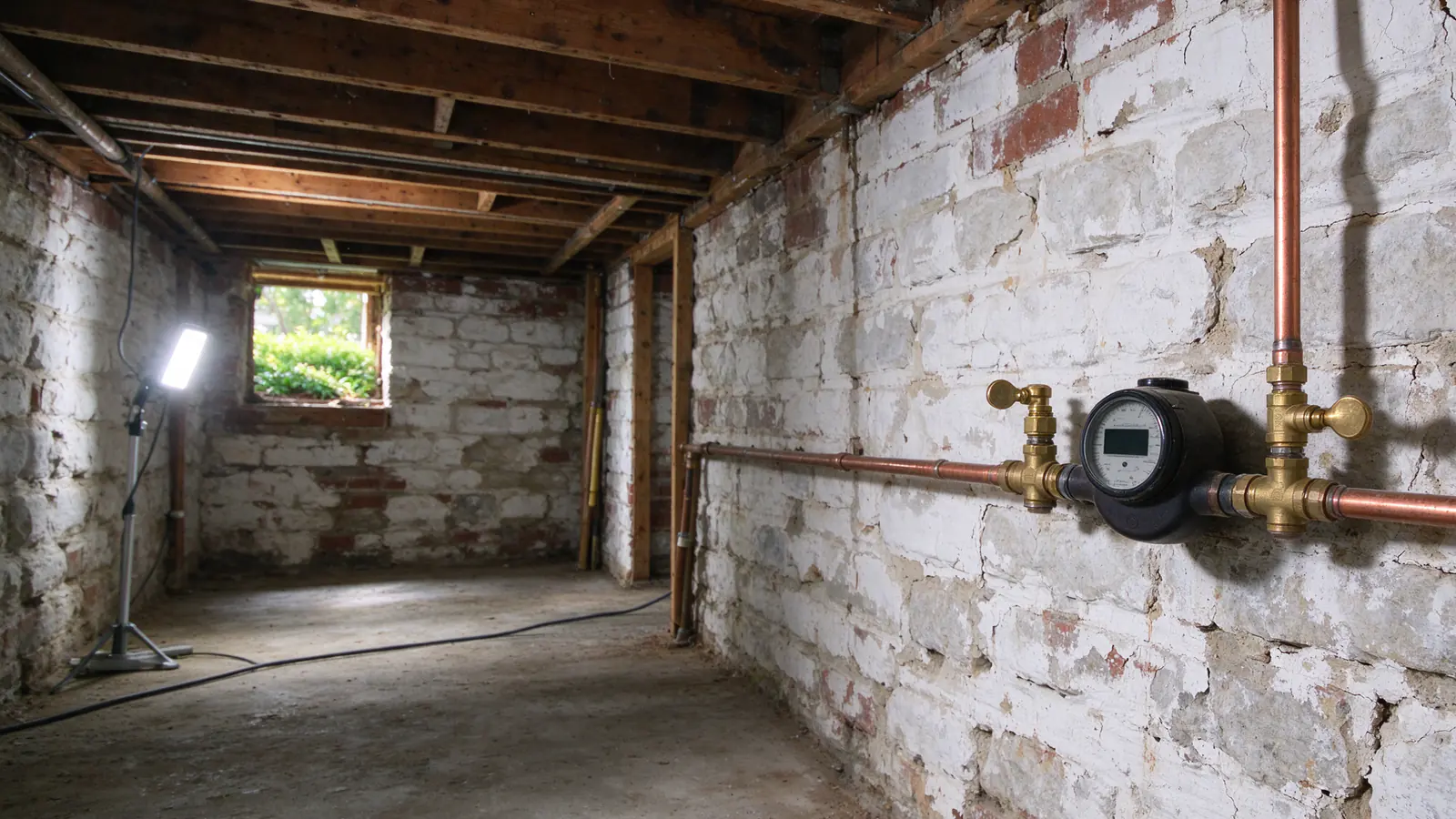
The first visit follows the water from where it enters the house. In a Philadelphia rowhouse the service line often comes through the front foundation wall to a meter and main shutoff inside the house; L&I service line permits are routinely written “curb to meter” or “sidewalk to front wall”. Whoever walks the house notes what that service line is made of, because a lead or galvanized service line can be the real limit on flow, and replacing it is a separate project covered on the lead service line replacement page.
From the meter, the walk-through traces the main to the water heater and up to each floor. It records what the pipe is on every level, where earlier repairs already switched sections to copper or PEX, and how many fixtures each branch feeds. Static pressure is read at a hose bibb or test point, and flow is compared at the lowest and highest fixtures with two taps open. Those numbers separate a house where old pipe chokes the flow from one where a half-closed valve, the service line or the fixtures are to blame.
The visit also maps routes: open basement joists, closets stacked above one another, the back of a kitchen cabinet, a chase beside the chimney. It ends with a written scope that names what gets replaced, where walls would open and what stays. Drains, vents and the sewer lateral stay out of a supply repipe unless the quote names them; the guide to whether repiping includes drains shows where that line falls.
Why supply pipe gives out in Philadelphia houses
Philadelphia’s housing is old. By Census figures, 39.9% of the city’s housing units were built in 1939 or earlier, 64.9% before 1960, and the median year built is 1949. In inner ZIP codes such as 19134 the pre-1940 share passes 70%. Houses of that age were plumbed with galvanized steel or have had decades of patch repairs in mixed materials.
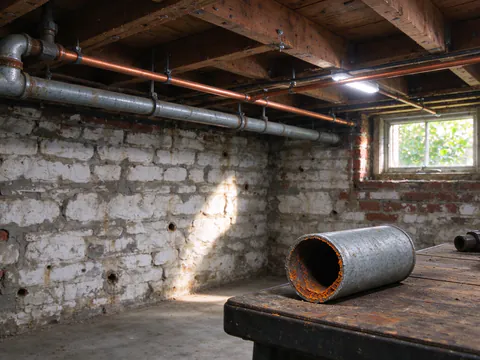
Galvanized pipe fails from the inside. The zinc coating wears through, the steel rusts, and scale builds on the pipe wall, so the bore narrows year by year while the outside can still look sound. The first sign is often flow, not a leak: the second-floor shower fades when the kitchen tap opens, or the first draw after a weekend away runs brown. Threaded joints are the weak point because the threads cut away part of the wall, so a joint inside a ceiling rusts through before the straight run beside it. Turning one corroded fitting to make a repair can crack the next one, which is how a small fix turns into a conversation about the whole system. The Philadelphia Water Department also notes that, over decades, lead from a property’s plumbing can collect on the corroded walls of galvanized pipe, one more reason owners look at replacing it rather than patching it. The guide to old water pipes in Philadelphia homes goes deeper into telling the materials apart.
Copper is not immune, and water chemistry is part of the reason. PWD’s tap water runs moderately hard to hard depending on the treatment plant: about 6 grains per gallon from the Baxter plant on the Delaware and 9 to 10 grains from the Schuylkill plants. PWD adds zinc orthophosphate to form a protective coating inside pipes, which helps both copper and old steel, but it does not make any pipe last forever. Pinhole leaks in copper can come from chemistry, water velocity or how the original joints were made.
None of these symptoms proves the cause on its own. Low pressure can come from the pipe, the service line, the main shutoff or a pressure-reducing valve, and brown water can come from the water heater or work on the street main. That is why a repipe is never sold here as a guaranteed pressure fix, and why the first visit measures before anyone describes a result.
Routing new pipe through a rowhouse
More than half of Philadelphia’s housing units, 55.6%, are single-family attached homes, and in ZIP codes such as 19134, 19148 and 19149 the share passes 77%. A rowhouse has party walls on both sides, so new pipe can only rise through the house’s own interior walls, closets and chases. That, and where the bathrooms sit relative to the kitchen, decides the layout.
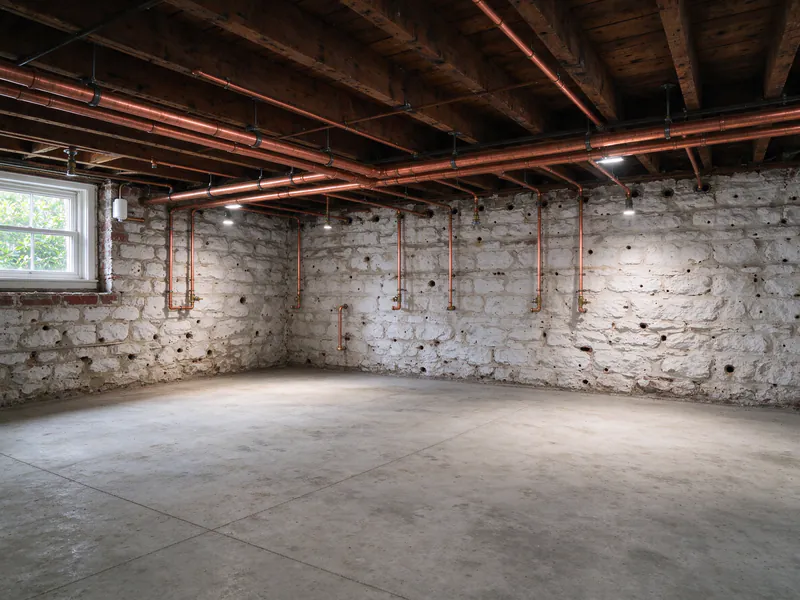
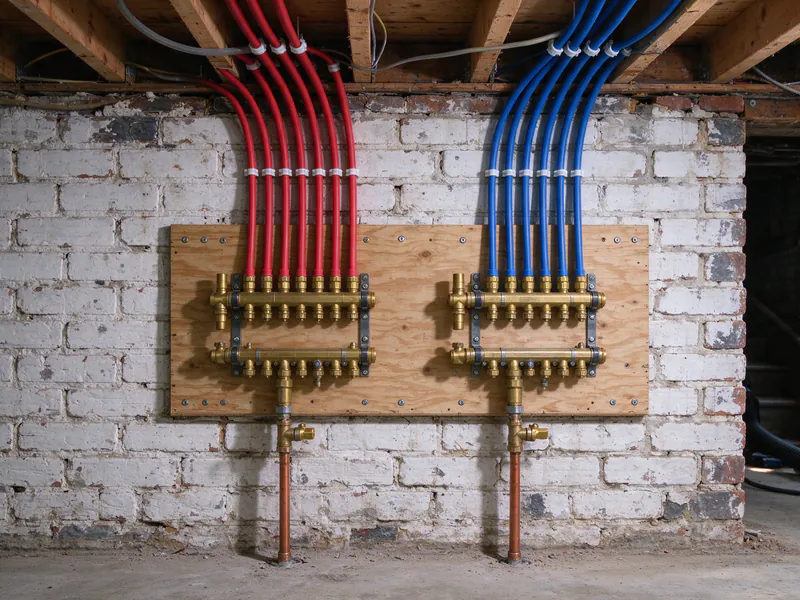
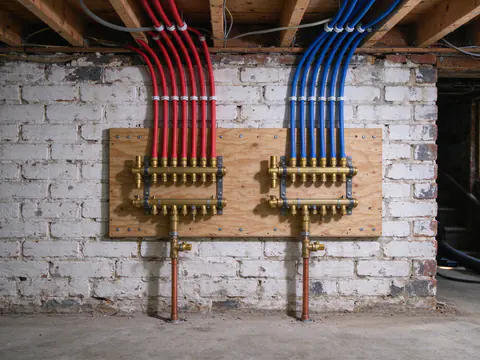
Where there is a basement, its joists carry the new hot and cold mains from the shutoff to the water heater and toward the back of the house. From there, one of two layouts takes over. A trunk-and-branch layout runs larger mains with smaller branches teed off to each fixture group, which keeps the pipe count low through tight floor framing. A home-run manifold layout gives each fixture its own line from a central manifold with its own shutoff, which makes service easier later but needs more lines up through the walls. The two can be combined: a manifold in the basement for the first-floor fixtures and a trunk up to the second-floor bathroom.
The Philadelphia code adds a rule that matters in attached housing: water distribution pipe may not cross adjoining property lines, and each building on a street with a main needs its own connection. New pipe stays inside your own walls, and a line found running through the party wall to the neighbor is a problem to resolve, not a route to reuse. The rowhouse repiping page covers attached-house layouts in more detail.
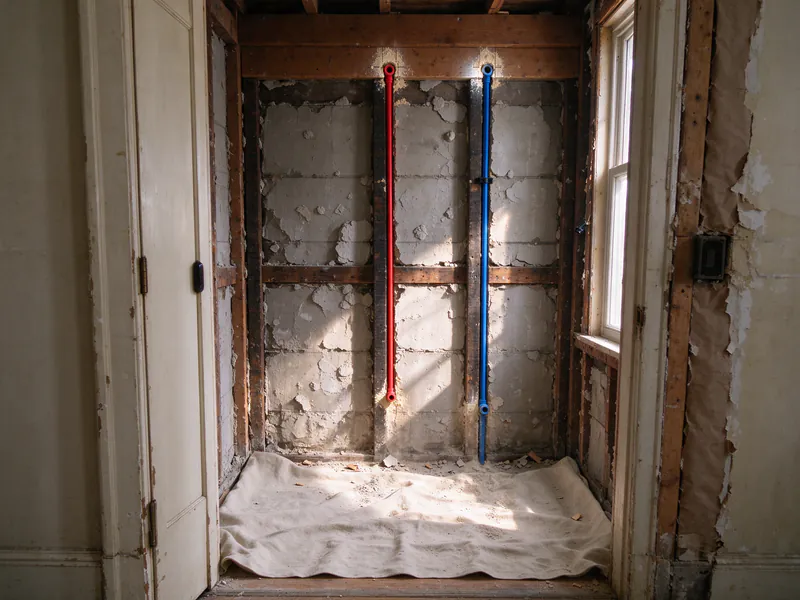
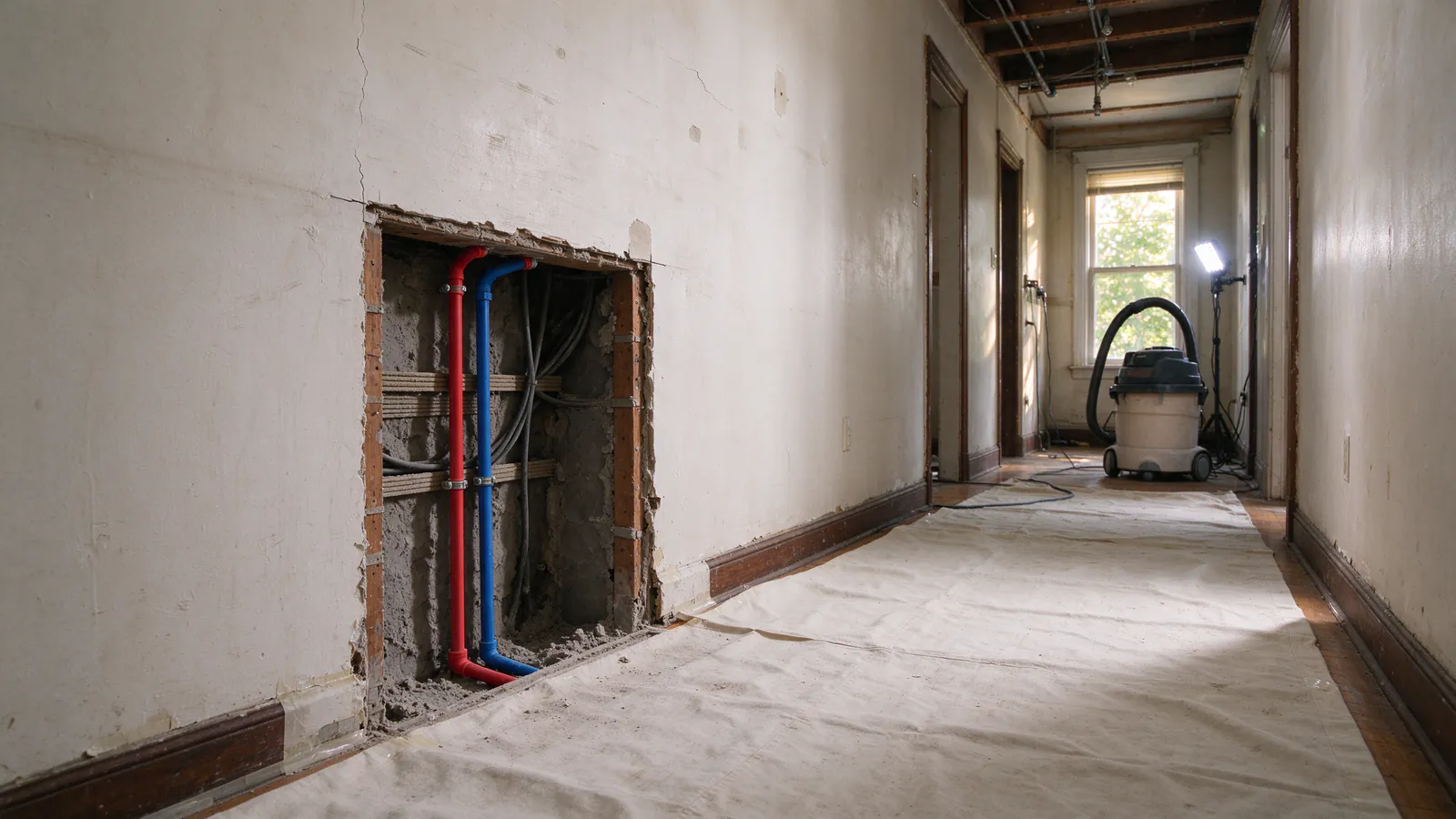
Where walls are plaster on wood lath, openings are cut as clean rectangles at the points where a fitting or a turn has to be made, rather than along the whole run. Tile around a shower is the hardest wall to open, so the plan tries to reach a shower valve from a closet or the room behind it. The guide to repiping plaster walls explains how openings are planned and closed.
Winter shapes the routing too. Philadelphia averages 77.3 days a year with a low at or below freezing, by NOAA’s 1991 to 2020 normals. Lines to a rear addition or an enclosed porch can cross cold floor framing, so the new route stays inside heated space where it can, away from outside walls, and is insulated where it cannot. New material alone does not remove freeze exposure.
PEX, copper and the Philadelphia material rule
The Philadelphia Plumbing Code, amended effective April 1, 2024, allows nonmetallic water piping such as PEX in one- and two-family dwellings and apartments. Section P-605.4 requires metallic piping for any water supply piping that serves or sits within any other occupancy, and P-605.4.1 requires metallic piping where an occupied floor is more than 75 feet above fire-access level. In practice, a rowhouse or twin can be repiped in PEX or copper, while a corner property with a store on the ground floor needs copper or another metallic pipe for the commercial space.
L&I’s own permit records show which way houses go. Of 52 whole-house or explicit water piping replacements permitted from October 26, 2023 to October 25, 2026, 32 named PEX and one named copper. Neither material is the right answer for every house. PEX bends around framing with fewer fittings and can be fished through plaster cavities with fewer openings. Copper is rigid, metallic, and required where the code calls for metal. The guide to whether PEX is allowed in Philadelphia and the PEX repiping page cover the choice in full.
A few details apply whichever pipe is chosen. Philadelphia’s EZ permit standards call for at least 4 feet of copper or similar metallic pipe at the water heater’s inlet and outlet, so a PEX system meets the heater through a metal section. Where a pressure-reducing valve, check valve or backflow assembly sits on the incoming supply, thermal expansion control is required. Press-connect and push-fit joints are allowed above ground only, and flexible water connectors are allowed only in one- and two-family dwellings and apartments, where they stay accessible. In the suburbs, townships enforce the statewide Pennsylvania Uniform Construction Code, which adopted the 2021 International Plumbing Code effective January 1, 2026.
Pressure testing, flushing and closing the walls
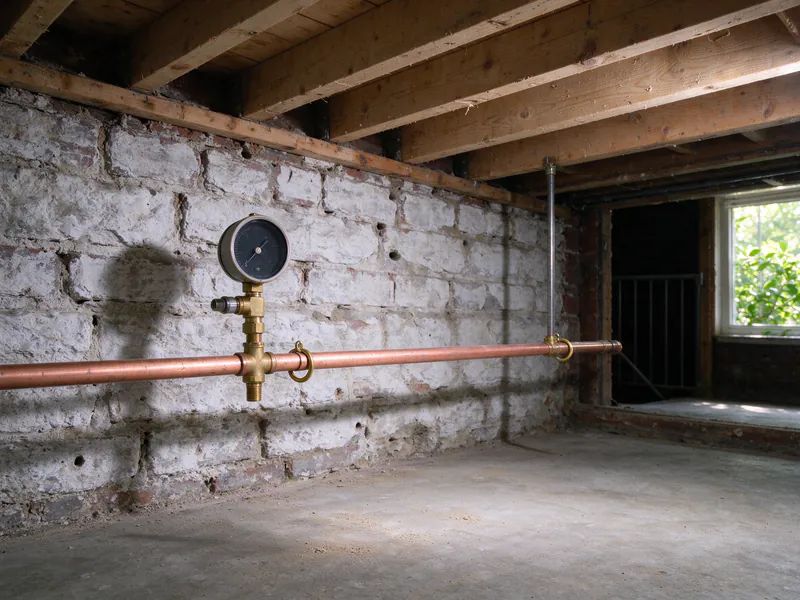
Before any wall or ceiling is closed, the new piping is pressure tested with the fixtures isolated, so a weak joint shows on a gauge rather than behind new plaster. After the cutover from old pipe to new, the lines are flushed to clear debris, and aerators and fixture screens are cleaned, because scale knocked loose from old valves can travel to the first faucet downstream. Shutoffs at the main and at each fixture group are labeled. Only then do the openings close, to the finish the quote names: rough patch, finished plaster or drywall, and paint are three different scopes.
Want to know what your house's repipe would include?
A walk-through from the meter shows the pipe on every floor, the routes and the openings.
Permit, inspection and paying for the work
Replacement plumbing in Philadelphia needs an L&I permit; only minor same-material repairs and stopping a leak are exempt. A repipe in a building with four or fewer dwellings and up to four stories can usually go through the EZ permit without plans. For a one- or two-family dwelling, L&I lists the alteration fee at $50 for the first 7 fixtures and $22.50 for each one after that, plus a $100 filing fee applied toward the final fee and small city and state surcharges. A Philadelphia licensed master plumber has to oversee the work. The Philadelphia repipe permit guide walks through the application and the inspection.
On price, a whole-house repipe of a single-family house or rowhouse typically runs $4,000 to $15,000+ around Philadelphia, and larger homes and copper jobs can pass $20,000. No City, state or federal program was found that pays for an interior repipe. PWD’s HELP loan and its free replacement programs are built around service line and exterior plumbing defects, not an interior repipe, so the owner pays for the piping inside. Planning the two together still helps, because a new service line decides where the main shutoff sits and what the new interior pipe connects to. The repipe cost estimator works from the same published ranges.
Related resources
- How much repiping costs in Philadelphia, with the factors that move a quote
- Living through a repipe: water-off windows, dust and access
- Galvanized pipe replacement when steel is the main problem
- Who can do plumbing work in Philadelphia and what the master plumber license requires
- Do I need a repipe?, a short check of the signs