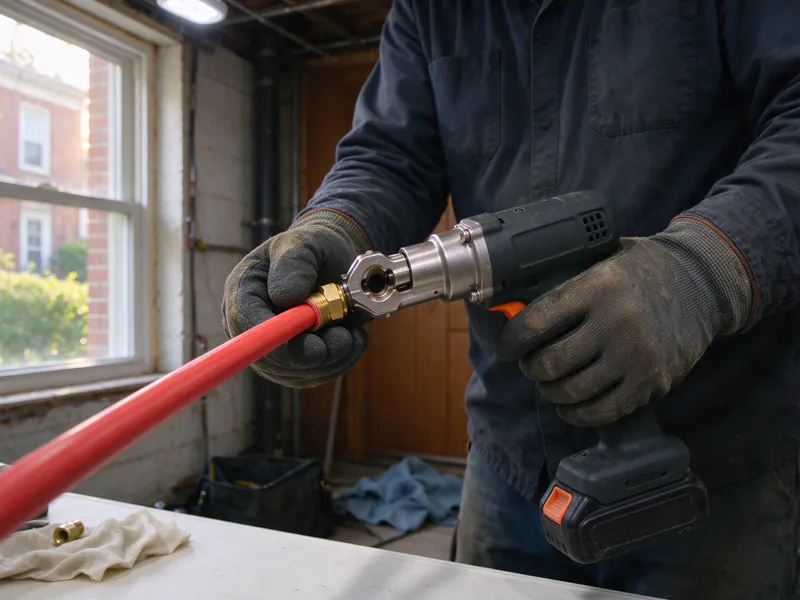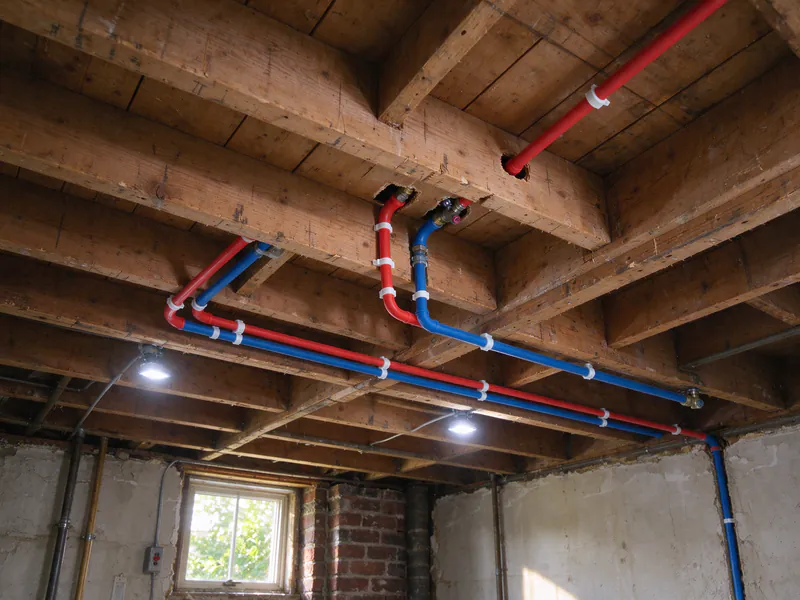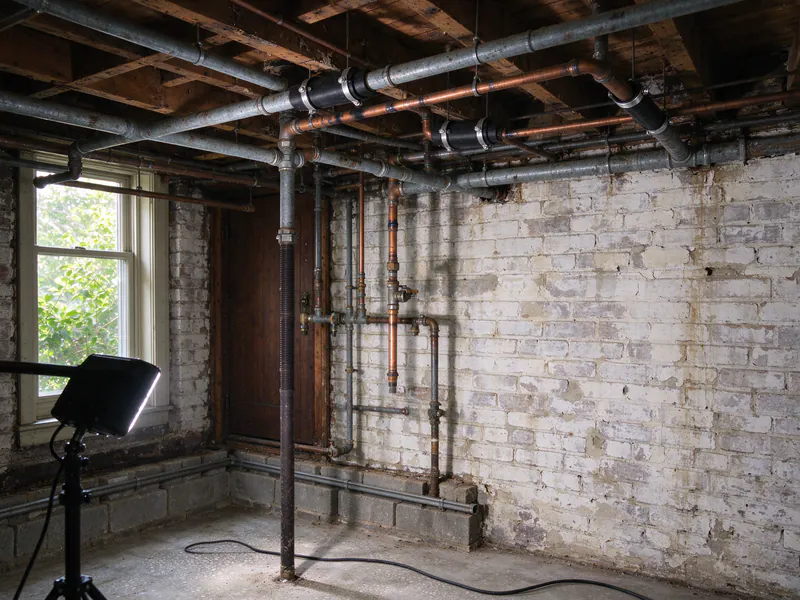
Philadelphia Freedom Repipe repipes houses in PEX across Philadelphia and nearby Delaware, Montgomery and Bucks County suburbs, in the buildings where the code allows plastic water pipe. PEX is crosslinked polyethylene tubing: flexible, listed for hot and cold drinking water, and joined with mechanical fittings rather than solder. It is the material most Philadelphia house repipes now use, and the reasons are practical. It also has firm limits under the City’s own plumbing code, and a few weaknesses that the installation has to account for. Licensed and insured contractors carry out the work; inside the city, a Philadelphia licensed master plumber oversees the job and pulls the L&I permit.
This page covers PEX specifically. For the full scope of replacing every supply line, see whole-house repiping; for the metal alternative, see copper repiping.
Where Philadelphia allows PEX, and where it does not
Philadelphia writes its own plumbing code. The 2018 Philadelphia Plumbing Code, as amended effective April 1, 2024, allows nonmetallic water piping such as PEX in one- and two-family dwellings and apartments. Section P-605.4 then draws the line: any water supply piping that supplies or sits within any other occupancy has to be metallic. That catches the corner rowhouse with a store, office or salon on the ground floor, where L&I-approved scopes state that all supply piping for the commercial space shall be metallic.
Height is the second limit. Under P-605.4.1, metallic piping is required in a building with an occupied floor more than 75 feet above the fire-access level, with a narrow exception for piping inside individual dwelling units in new construction. A house never reaches that height, but a mid-rise apartment building can.
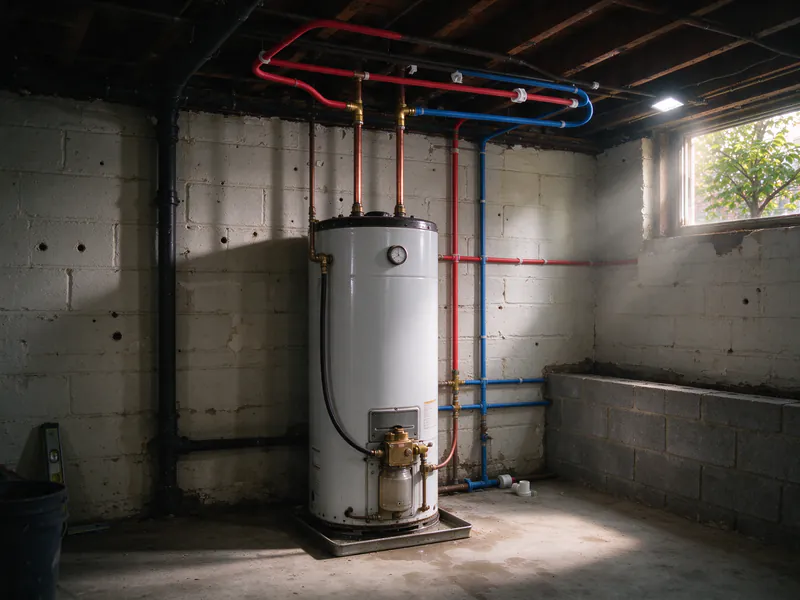
The third limit sits at the water heater. Philadelphia’s EZ permit standards call for at least 4 feet of developed length of copper or similar metallic pipe at the heater’s inlet and outlet, so a PEX system meets the heater through metal. The code also allows press-connect and push-fit joints above ground only. L&I’s summary of the Philadelphia plumbing code amendments sets out these sections, and the guide is PEX allowed in Philadelphia goes through them one at a time.
In the suburbs, townships enforce the statewide Pennsylvania Uniform Construction Code, which adopted the 2021 International Plumbing Code effective January 1, 2026; each township or borough’s own permit and contractor rules apply.
Why most Philadelphia house repipes are PEX
L&I’s permit records show the trend plainly. Of 52 whole-house or explicit water piping replacements permitted between October 26, 2023 and October 25, 2026, 32 named PEX and one named copper; the recurring approved wording is “install new PVC and PEX piping throughout single family dwelling”. The reasons come from the houses.
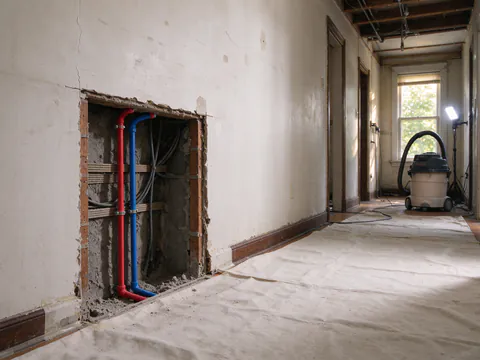
A rowhouse has party walls on both sides and plaster on the rest. Rigid pipe needs a straight path or a fitting at every turn, and every fitting inside a finished wall means an opening. PEX bends around framing, can be fished down a stud bay from an opening at the top, and comes off a coil in long continuous runs, so a riser from the basement to the second-floor bathroom can go up with few or no hidden joints. Fewer joints in a wall means fewer openings and fewer places to leak. That is the main practical case for PEX in an old house, and it is why the guide to repiping plaster walls assumes PEX for most of its examples.
None of this makes PEX the right material for every house. The PEX vs copper repipe guide sets out where copper is the better or the required choice.
PEX-A and PEX-B
All PEX is polyethylene crosslinked so it keeps its shape under heat and pressure. The letters describe how the crosslinking was done, and that changes how the tubing behaves on the job.
PEX-A is the most flexible. It bends tighter without kinking, and a kink can usually be recovered with heat. It is the tubing used with expansion fittings, where the tube end is expanded, pushed over the fitting and shrinks back to grip it. The fitting bore stays close to the tube’s own inside diameter.
PEX-B is stiffer and holds a coil memory longer, so it needs more bend supports and fastening to lie flat. It is usually joined with crimp or clamp rings, or press sleeves, on insert fittings. Insert fittings narrow the bore at each joint, which matters on a long run with many fittings feeding a shower upstairs, and matters little on a short branch.
Both are listed for drinking water when made to the relevant standards, and both are installed by the manufacturer’s instructions and the Plastics Pipe Institute’s PEX design guide. The important rule is consistency: one tubing and fitting system, matched to the listing, through the whole job.
Want to see how PEX would route through your house?
The walk-through maps the risers, the basement mains and where the metal sections go.
Manifold or trunk-and-branch
A trunk-and-branch layout runs larger mains, usually 3/4 inch, with smaller branches teed off to each fixture group. It uses less tubing and suits narrow rowhouse framing, where there may be one good chase to the second floor.
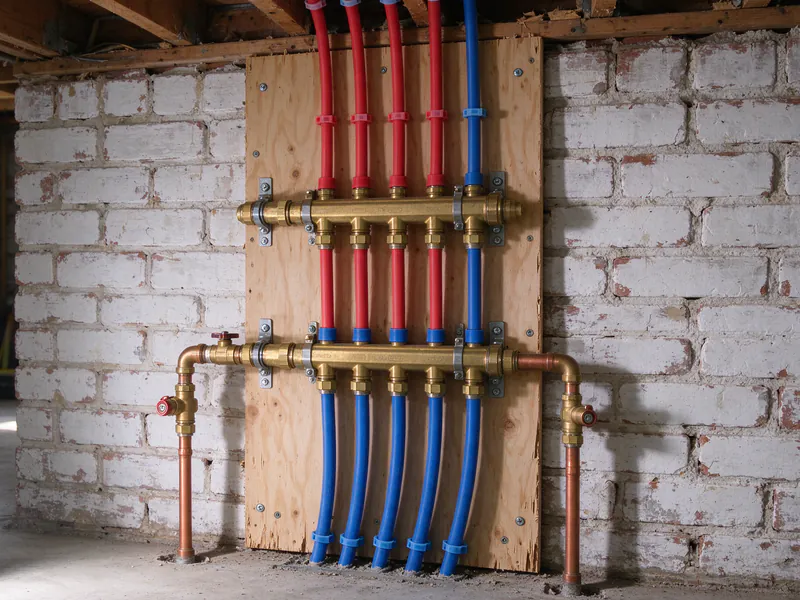
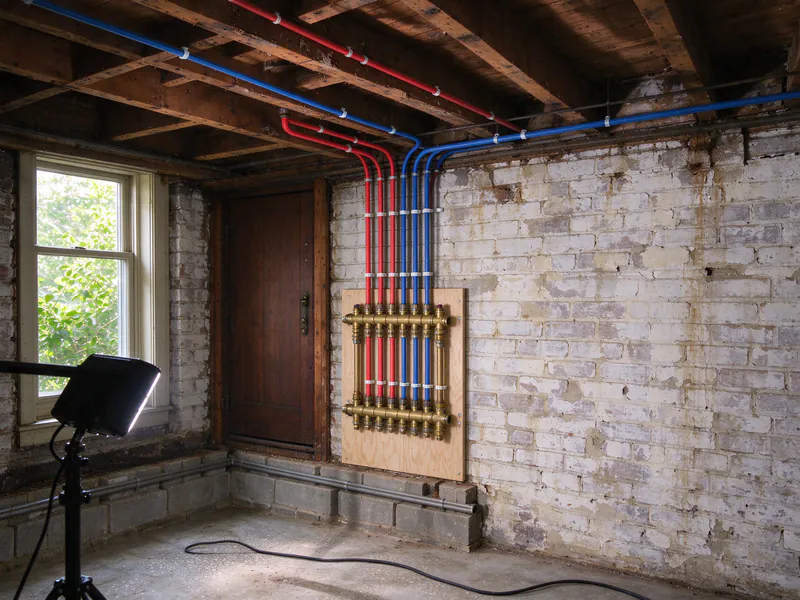
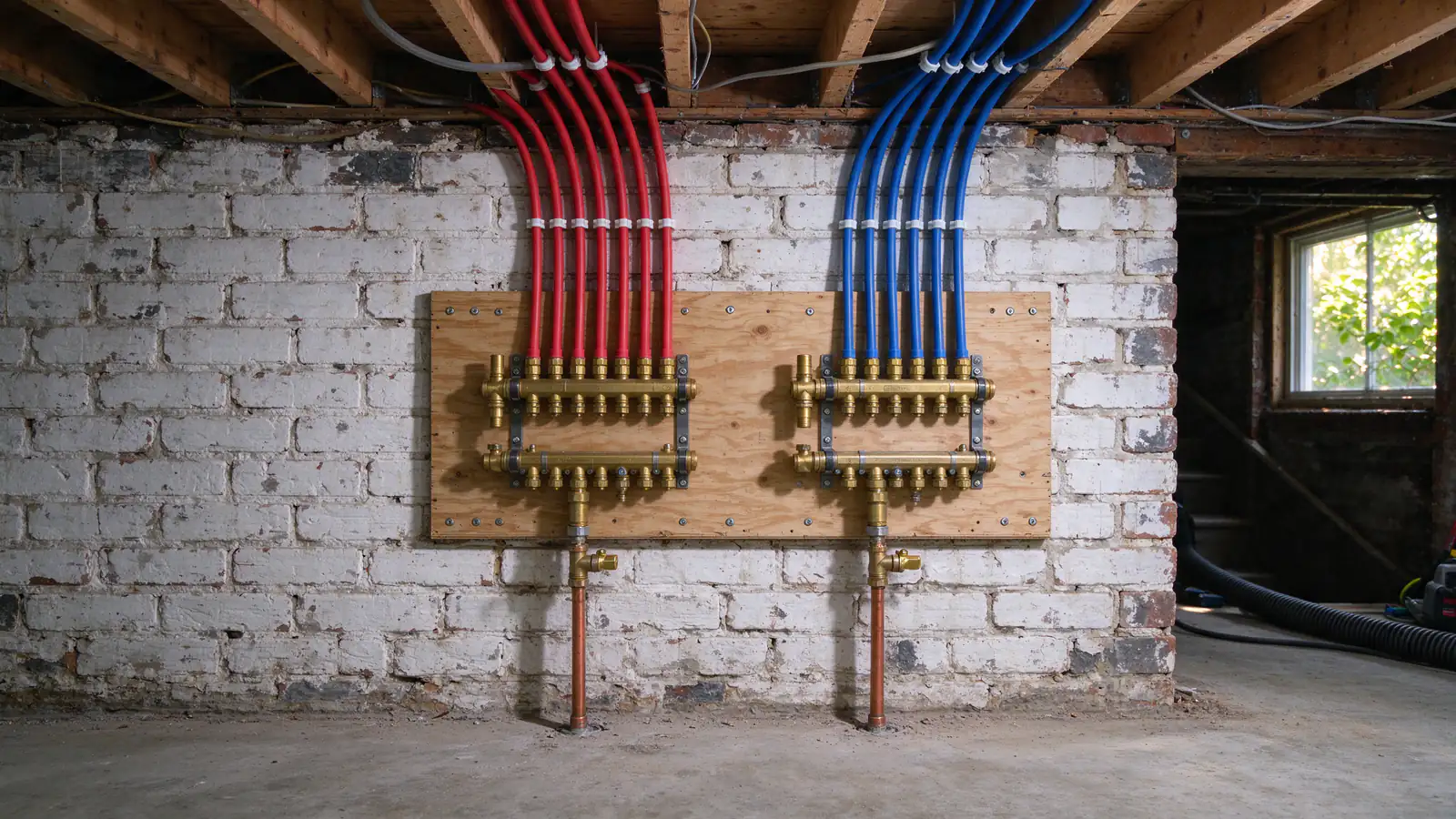
A home-run manifold layout gives every fixture its own line from a central manifold, each with its own shutoff. A single fixture can be shut off without losing the bathroom, and the manifold ports can be labeled by room. It needs more lines through the walls, which can mean a larger chase.
Many Philadelphia repipes combine them: a manifold in the basement for the first-floor fixtures and a trunk up to the bathroom with a small manifold or branch tees there. The rowhouse repiping page shows how that plays out in a narrow plan.
What PEX does not tolerate
PEX does fail when it is installed badly, and the installation has to answer for four things:
- Sunlight. Ultraviolet light breaks PEX down. Tubing is stored out of the sun and never left exposed outdoors or under a skylight.
- Heat. PEX stays clear of flues, recessed lights and the water heater’s hot connections; the code’s metallic section at the heater handles the last.
- Rodents. Mice and rats can chew plastic tubing in basements and crawl spaces. Tight runs, sleeves at openings and sealing gaps reduce that exposure.
- Freezing. Philadelphia averages 77.3 days a year with a low at or below freezing on NOAA’s 1991 to 2020 normals. PEX stretches more than copper as ice forms, but fittings and valves on a frozen line can still crack. New lines stay inside heated space where possible and are insulated where they cannot.
PEX also expands and contracts with temperature more than copper does, so long runs get room to move rather than being clamped tight at both ends.
Testing, flushing and closing up
Before any wall or ceiling closes, the new system is pressure tested with fixtures isolated so a weak joint shows on a gauge. After the cutover from old pipe, the lines are flushed and aerators cleaned, and each shutoff or manifold port is labeled. Openings close to the finish the quote names. The guide to living through a repipe covers water-off windows and daily routine during the job.
Price, permit and who does the work
A PEX repipe of a typical home runs about $4,000 to $10,000 by area pricing, with large homes higher. For a one- or two-family dwelling, L&I lists the alteration permit at $50 for the first 7 fixtures and $22.50 for each additional one. The repiping cost guide for Philadelphia breaks the drivers down, and the Philadelphia repipe permit guide covers the application and inspection.
Related resources
- Galvanized pipe replacement, the most common starting point for a PEX repipe
- Repipe cost estimator built on the published ranges
- Philadelphia plumbing code update for the pending 2021 code bill