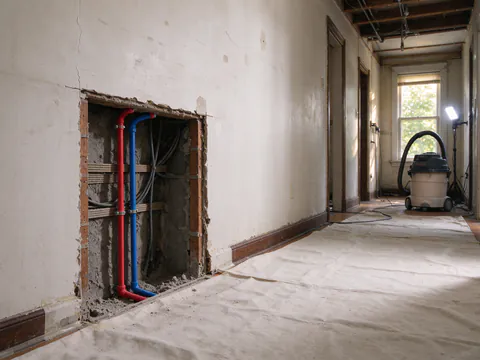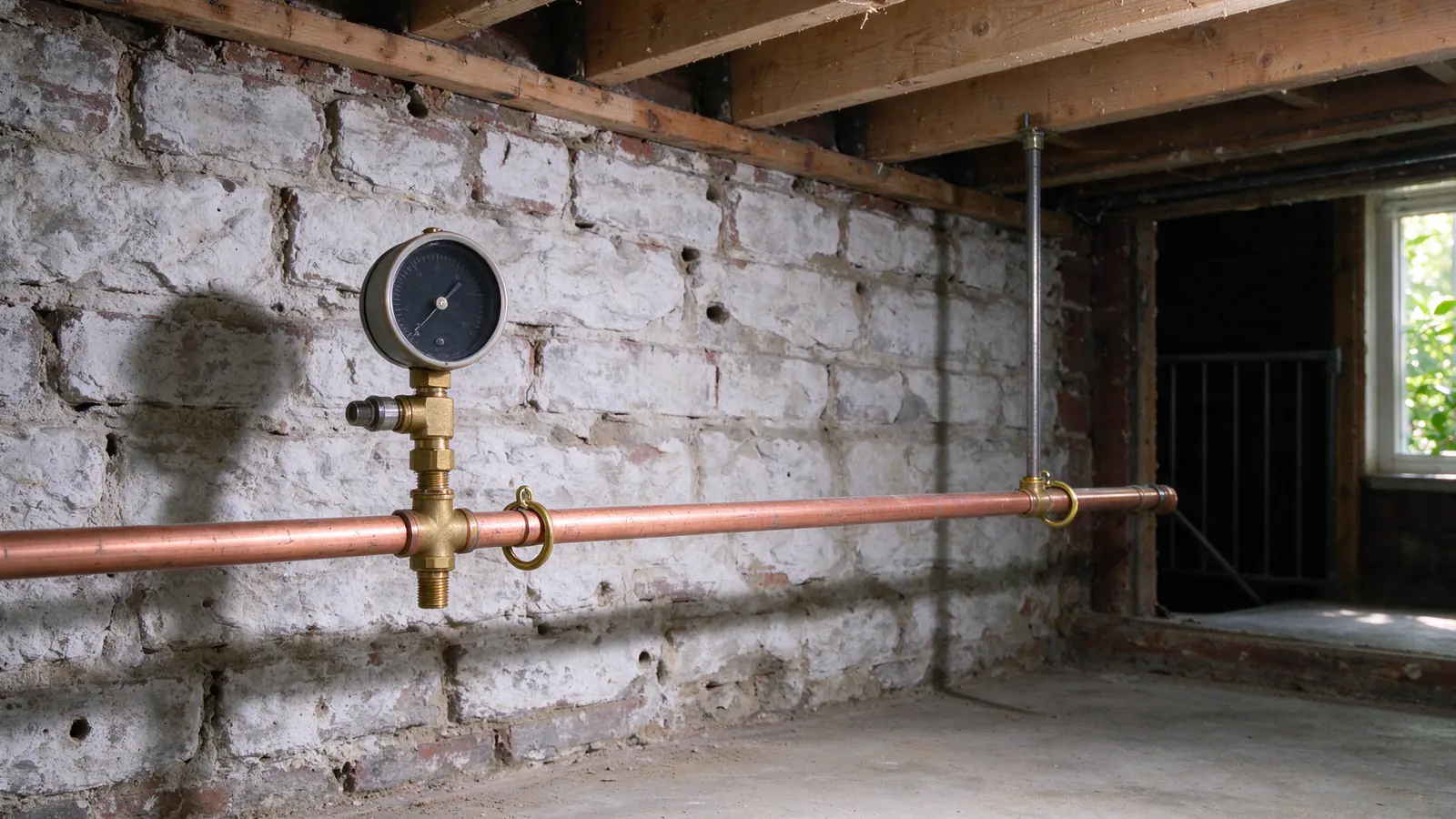
Yes. In Philadelphia, replacing water piping is plumbing work that needs a permit from the Department of Licenses and Inspections, and a licensed master plumber must oversee it. Only minor repairs in the same material and work to stop a leak are exempt. Most rowhouse repipes go through L&I’s EZ permit, which needs no plans.
Philadelphia Freedom Repipe offers and manages whole-house repiping and partial repiping across Philadelphia and nearby Delaware, Montgomery and Bucks County suburbs. Licensed and insured contractors carry out the work; inside the city, a Philadelphia licensed master plumber oversees the job and pulls the L&I permit. This guide explains how that permit works, what it costs on L&I’s published schedule, and what the inspection is for.
When a permit is needed
L&I’s rule on its get a plumbing permit page is broad: you need a permit for plumbing work, and that includes replacement and repair. Two kinds of work are exempt: minor repairs that use the same material, and stopping a leak. Replacing a cracked fitting with the same fitting fits the exemption. Replacing galvanized steel with PEX, re-running a riser, or repiping a bathroom group or the whole house does not.
The reason the city draws the line there is that a repipe changes the system. It changes the material, the pipe sizes, the valves and the connections at the water heater, and those are the things the plumbing code governs. The is PEX allowed in Philadelphia guide covers the material rules an inspector checks.
Who can apply and who must oversee the work
L&I lets any property owner or their authorized agent apply for a plumbing permit. Being able to apply is not the same as being able to do the work: a licensed master plumber must oversee plumbing work, with an active license, City taxes current and insurance on file. Where someone other than the master plumber applies, L&I asks for a signed statement on the master plumber’s letterhead. L&I’s EZ standard forms carry the registered master plumber’s number and signature.
In practice, the master plumber overseeing the job usually files the application, because the permit, the standards form and the inspection all run through that license. The guide to who can do plumbing work in Philadelphia explains the license and what a homeowner can and cannot do.
The EZ permit
Most rowhouse and twin repipes do not need drawings. L&I’s EZ permits, issued without plans, cover alterations in buildings with four or fewer dwellings and up to four stories, along with pipe repair and new or replacement water service to a single building. The EZ permit comes with a set of EZ plumbing permit standards that the work must meet. For a repipe, the ones that shape the design are:
- at least 4 feet of developed length of copper or similar metallic pipe at the water heater’s inlet and outlet;
- thermal expansion control wherever a pressure-reducing valve, check valve or backflow assembly sits on the incoming supply;
- R-3 insulation on hot water pipe of 3/4 inch and larger, pipe serving more than one dwelling, pipe outside conditioned space and buried pipe.
Larger buildings, more stories or work outside the EZ scope go through plan review. L&I does not offer rough-in permits for one- and two-family dwellings.
What the permit costs
L&I publishes its plumbing fees in its summary of construction permit fees. Two fee lines can apply to a repipe, and which one L&I uses for a given job, an alteration with fixtures or a repair and replacement of water lines, is L&I’s decision.
| Fee line | One- or two-family dwelling | Other occupancies |
|---|---|---|
| Alterations to existing buildings | $50 for the first 7 fixtures, plus $22.50 for each additional fixture | $189 for the first 7 fixtures, plus $22.50 for each additional fixture |
| Repair or replacement of water lines, waste lines or stacks | $37, no fixtures | $126 each pipe |
Every permit also carries fixed charges:
| Charge | Amount |
|---|---|
| Filing fee | $100, paid at application and applied toward the final fee |
| City surcharge | $3 |
| State surcharge | $4.50 |
| Record retention | $4 per plan |
| Card payment | 2.10% by credit card (minimum $1.50), or $3.45 by debit card |
| Accelerated plan review, optional | $1,050 |
A worked example shows how small the permit is next to the job. A two-story rowhouse with ten fixtures, treated as an alteration, would carry a fixture fee of $50 plus three times $22.50, or $117.50, with the surcharges added and the $100 filing fee credited toward it. The repiping cost guide shows where the permit sits in the full price, and the repipe cost estimator uses the same published figures.
Inspection
The permit is what brings an L&I inspector to the job. The inspection checks the work against the code and the EZ standards: the material for the occupancy, the metallic section at the water heater, expansion control, insulation where required, and sound, supported, leak-free piping. The practical consequence for the homeowner is timing. New pipe should be pressure-tested while every joint is still visible, and when L&I needs to see the piping before walls close is set between the inspector and the master plumber on the permit, so the plaster goes back on that schedule rather than the day the pipe is in.
That sequence is built into how the work is done: the new system is pressure-tested and flushed before walls close, shutoffs are labeled, and the written scope lists each opening and who closes it. The living through a repipe guide covers how that affects the days in the house.
The service line is a separate permit
A repipe starts at the main shutoff inside the house. Replacing the water line from the curb stop into the building is a separate L&I permit, listed at $126. Work that disturbs the sidewalk needs a Streets Department footway permit, issued automatically with the plumbing permit, and the Philadelphia Water Department handles its own permits for main connections and meters. The lead service line replacement page covers that work.
Outside the city
Suburban townships and boroughs run their own permits under the Pennsylvania Uniform Construction Code. Each township or borough’s own permit and contractor rules apply: Upper Darby requires a permit before water piping is installed or changed and limits who may apply, and Norristown keeps its own licensed-contractor list. Fees there are set locally and are not on L&I’s schedule.