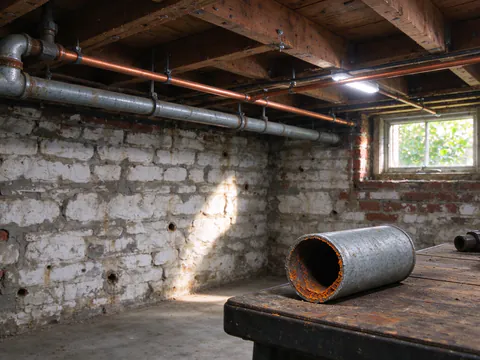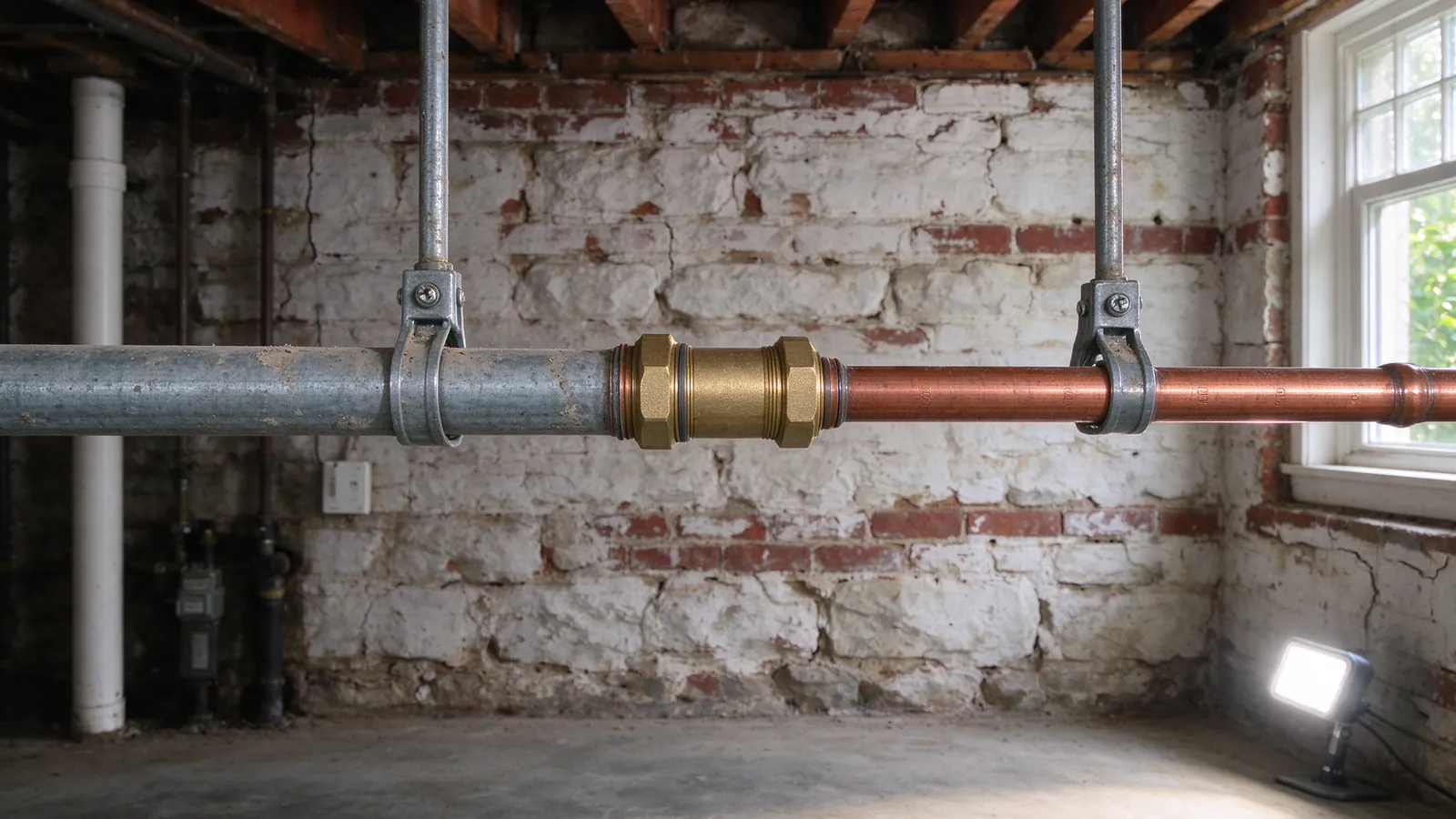
Start at the water meter and test the exposed pipe with a coin and a magnet. Galvanized steel is gray, magnetic and threaded. Lead is gray, soft, shiny when scratched and not magnetic. Copper scratches to a penny color. PEX is flexible colored plastic printed “PEX”. CPVC is rigid cream plastic. Polybutylene is gray plastic, rarely found in Philadelphia.
Philadelphia Freedom Repipe offers and manages galvanized pipe replacement and whole-house repiping across Philadelphia and nearby Delaware, Montgomery and Bucks County suburbs. Knowing what pipe you have is the first step in deciding whether you need either, and most of it can be worked out in ten minutes in the basement. This guide explains where to look and what each test tells you.
Where to look in a rowhouse basement
In most Philadelphia rowhouses and twins, the water service comes through the front or foundation wall into the basement, and the meter and main shutoff sit just inside. L&I permits for service work describe the same layout, from the curb stop “to water meter inside home” or “sidewalk to front wall”. That front corner is the best place to start, because it shows two separate pipes: the service line arriving from the street, and the house piping leaving the meter.
From there, follow the pipe that leaves the meter. It usually runs along the basement ceiling toward the back of the house, sends a branch to the water heater and climbs through a closet, a stair wall or a chase to the kitchen and bathroom. Other places where pipe is often exposed:
- the water heater connections, hot and cold;
- the washer box or laundry tub;
- under the kitchen sink and bathroom vanity;
- behind an access panel at the tub;
- the hose bibb line at the front or rear wall.
Check several of these. A hundred-year-old house rarely has one material throughout, and the pipe at the meter may be newer than the risers behind the plaster.
The two tests
The U.S. Environmental Protection Agency’s Protect Your Tap quick check describes the method, and the Philadelphia Water Department’s check your service line page uses the same steps for the line at the meter.
Scratch test. Gently scrape a small area of the pipe with a coin or a key, enough to get past paint and surface grime. Note the color underneath.
Magnet test. Hold an ordinary fridge magnet against the pipe. Note whether it sticks firmly, weakly or not at all.
Only test pipe that is exposed and sound. Do not scrape a joint that is weeping, a fitting under strain or anything you suspect is about to fail.
What each material looks like
| Material | Scratch shows | Magnet | Joints and other signs |
|---|---|---|---|
| Galvanized steel | Dull gray, same as the surface | Sticks firmly | Threaded fittings; rust staining at the threads |
| Lead | Bright, shiny silver; metal is soft | Does not stick | Rounded bulge at joints; mostly on the service line |
| Copper | Penny color; surface brown or green with age | Does not stick | Soldered, pressed or compression joints; never threaded into the pipe |
| PEX | Plastic | Does not stick | Flexible; white, red or blue; printed “PEX”; crimp, clamp or expansion fittings |
| CPVC | Plastic | Does not stick | Rigid, cream or tan; solvent-cemented joints |
| Polybutylene | Plastic | Does not stick | Flexible and gray; may be printed “PB2110” |
Galvanized steel
Galvanized is steel pipe coated with zinc, and it was a common supply pipe inside houses built through the first half of the twentieth century. It corrodes and scales from the inside, so the outside can look fine while the bore has narrowed. That is why it is linked with weak flow upstairs and discolored first draws. The galvanized pipe replacement page explains how it is replaced.
Lead
Lead is found mainly on the service line where it enters the house. PWD notes that lead can also be hidden in older solder, fittings, faucets and brass, and that lead from a property’s plumbing can build up on the corroded walls of galvanized pipe. If the line at the meter tests as lead, the lead service line check guide explains what to do next.
Copper
Copper replaced galvanized in later decades and turns up in older houses wherever a repair, a bathroom or a rehab replaced a section. Where copper meets galvanized there should be a brass fitting or a dielectric union. Copper’s main failure mode is the pinhole leak, covered in the copper pinhole leaks guide.
PEX, CPVC and polybutylene
PEX is the plastic of recent Philadelphia work: of the 52 whole-house water-piping replacements L&I permitted over the three years to October 2026, 32 named PEX. CPVC is far rarer in the permit record, named in one permit in the same three years. Polybutylene, the gray plastic with a poor record elsewhere in the country, appears in none of the 97,821 plumbing permits issued in the city since 2009. That does not prove none exists, but it is not a Philadelphia pattern. Read the printing before deciding, because PEX also uses crimp rings.
What the result means
Identification narrows the question; it does not answer it. Galvanized from the meter to the fixtures usually points to a whole-house repipe, but low pressure and rusty water can have other causes, as the low water pressure guide and the rusty water guide explain. A lead or galvanized service line is a separate job from the house piping. Copper or PEX throughout may need nothing at all.
Philadelphia Freedom Repipe replaces old supply piping after a walk-through that starts at the meter and maps every run, so the scope is based on what is actually in the walls. The do I need a repipe tool turns what you found into a next step, and the old water pipes guide gives the full background.